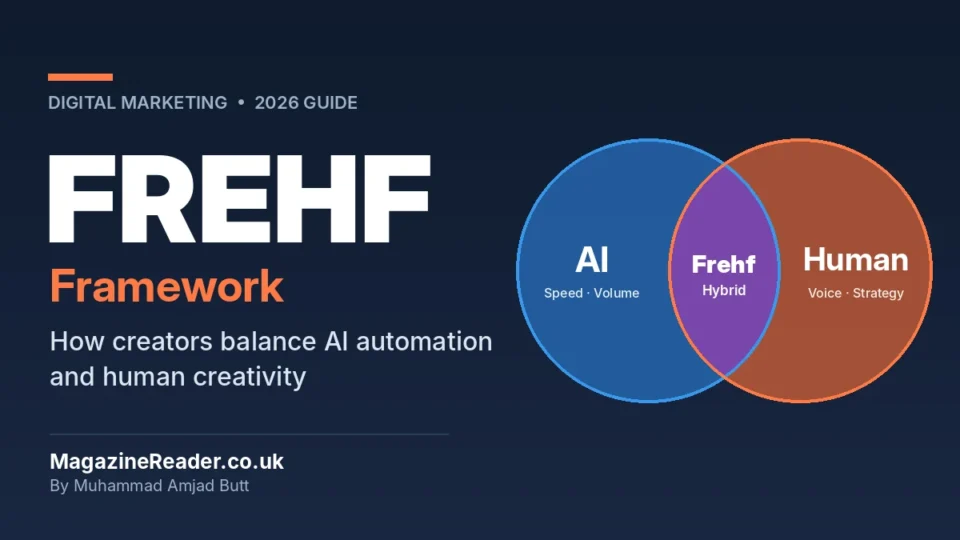
Quick Answer: Frehf (Future Ready Enhanced Human Framework) is a workflow model that uses AI for speed and volume while humans keep control of strategy, brand voice and final quality. It rests on four pillars: Strategic Alignment, Data Awareness, Behavioural Insight and Iterative Improvement.
By Muhammad Amjad Butt, Founder of Magazine Reader, practising SEO since 2006. Updated 25 November 2026.
What Is the Frehf Framework?
FREHF stands for Future Ready Enhanced Human Framework. It’s a way to split creative work between AI and people so each side does what it’s best at.
Older automation thinking tried to replace human work. Frehf does the opposite: it uses AI to enhance the creator, not stand in for them.
The shift is already moving beyond content. AI agents are starting to handle buying decisions too, as we explain in ChatGPT Wallet Explained. The more AI does for your audience, the more your human voice becomes the reason they choose you.
We should be clear about one thing. Frehf is not an official standard or a piece of software. It’s an emerging framework name used across business and creator circles, and the value lies in applying its principles, not in the label.
After nearly 20 years in SEO, we’ve seen this pattern before. Every new tool (article spinners, content mills, now AI) tempts people to swap judgement for volume. The creators who last are the ones who use the tool and keep the judgement.
What Are the 4 Pillars of the Frehf Framework?
Each pillar answers one question you should ask before AI touches your content.
1. Strategic Alignment: Does this serve my goal?
Every AI task must link back to a business goal, such as email signups, affiliate clicks or client leads. If a task doesn’t move a goal, don’t automate it. Drop it.
Tying work to results also makes it easier to win support for your plans. We cover that in why some marketers get bigger budgets.
Creator example: A food blogger’s goal is recipe-page traffic from Google. She uses AI to draft ingredient substitution tables (useful and quick) but writes the personal “why this recipe works” intro herself, because that’s what builds return readers.
2. Data Awareness: What do my numbers actually say?
Decisions should come from your own analytics, not from AI guesses. AI can summarise your Google Search Console export, but you decide what the patterns mean.
Creator example: A tech YouTuber exports 90 days of video stats. ChatGPT spots that videos under 9 minutes have higher average view duration. He then tests shorter scripts for four weeks before changing his whole format.
3. Behavioural Insight: How do real people react?
AI can’t feel what your audience feels. This pillar keeps comments, replies, DMs and survey answers at the centre of your content plan.
Creator example: A personal finance newsletter writer reads every reply to her weekly email. When 12 readers ask the same question about ISAs, that becomes next week’s lead story. AI then helps her format it, not choose it.
4. Iterative Improvement: What will I change next week?
Frehf is a loop, not a one-time setup. You review results weekly, keep what works and cut what doesn’t.
Creator example: A LinkedIn ghostwriter tracks which AI-assisted posts get edited the most. Posts needing heavy rewrites show the prompt is weak, so she rewrites the prompt rather than repeatedly fixing the outputs.
Creative Output vs. Creative Capacity: What’s the Difference?
This is the idea most Frehf guides skip, and it’s the one that matters most.
Creative Output is what AI is great at: speed, volume and variations. Think 20 headline options, 10 ad copy versions, a first draft in 90 seconds, or captions for a week of posts.
Creative Capacity is what only you bring: deep strategy, a recognisable brand voice, lived experience and emotional connection. It’s why a reader picks your post over 50 similar ones.
- Output scales with tools. Buy a better AI subscription and you get more of it.
- Capacity scales with rest, reading and real experience. No subscription upgrades it.
- The trap: pushing output up while capacity drains. Volume rises, quality falls, and readers notice before you do.
A simple rule we use: let AI multiply your ideas, never originate your positioning.
What Is the Human Review Layer and the Escape Hatch?
The human review layer: a mandatory checkpoint
The human review layer is a non-negotiable step between “AI draft” and “Publish”. Nothing goes live without a person reading it in full.
In our workflow, the reviewer checks five things:
- Facts: Every number, date, name and claim is verified against a primary source.
- Experience: At least one first-hand example, screenshot, test result or opinion is added.
- Voice: It sounds like you. Read the intro aloud; if it sounds like a brochure, rewrite it.
- Intent match: The first 100 words answer the searcher’s actual question.
- Filler sweep: Generic phrases, repeated points and empty conclusions are cut.
Tip: Do the review in a separate session, ideally a few hours after drafting. Fresh eyes catch problems that tired eyes skip.
The escape hatch: what to do when AI output is off-brand
The escape hatch is a pre-agreed rule for when you stop fixing AI output and switch to manual. Without it, creators waste an hour polishing a draft that should have been binned in five minutes.
Trigger the escape hatch when any of these happen:
- You’ve edited more than 50% of the draft and it still doesn’t sound like you.
- The draft contains a factual error you didn’t catch until the second read.
- Two prompt rewrites still produce generic, could-be-anyone content.
- The topic depends on personal experience, a sensitive subject or a strong opinion.
The escape hatch protocol:
- Stop editing. Close the AI draft.
- Write a rough outline by hand in 10 minutes: your angle, your example, your verdict.
- Write the core sections yourself.
- Bring AI back only for support tasks: formatting, a meta description, alt text, social snippets.
- Log what went wrong so you can fix the prompt or remove that task from automation.
Which Tools Should Creators Use at Each Step?
Here’s a practical blog-post workflow. Each step shows who leads: AI, Human, or both.
| Step | Task | Tool Examples | Who Leads |
|---|---|---|---|
| 1 | Pick topic and angle | Google Search Console, reader emails, comments | Human (AI may summarise data) |
| 2 | Keyword and question research | Google autocomplete, People Also Ask, ChatGPT for clustering | AI assists, human decides |
| 3 | Outline | ChatGPT, Notion AI | AI drafts, human approves |
| 4 | First draft of factual sections | ChatGPT, Claude, Notion AI | AI |
| 5 | Intro, opinions, personal examples | Your own keyboard | Human only |
| 6 | Fact-check and review layer | Primary sources, official sites | Human only |
| 7 | Meta description, alt text, schema draft | ChatGPT, Rank Math or Yoast | AI drafts, human checks |
| 8 | Images and graphics | Canva, your own photos | Both |
| 9 | Publish and distribute | Zapier or Make (WordPress → social, newsletter) | Automation |
| 10 | Weekly results review | GA4, Search Console, Notion dashboard | Human (AI may summarise) |
Where to automate with Zapier: New WordPress post → auto-create a Notion review task → after approval, schedule social posts → log the URL in a tracking sheet. These are repetitive steps where mistakes are low-risk.
Where never to automate: Publishing without review, replying to readers, and any claim about health, money or legal matters.
100% Manual vs. 100% AI vs. Frehf Hybrid: Which Workflow Wins?
| Factor | 100% Manual Workflow | 100% AI Automation | Frehf Hybrid Model |
|---|---|---|---|
| Time per 1,500-word post (typical) | 5–8 hours | 15–30 minutes | 2–3.5 hours |
| Publishing volume | Low | Very high | Medium to high |
| Brand voice | Strong | Weak, generic | Strong |
| First-hand experience (E-E-A-T) | High | Missing | High |
| Factual accuracy risk | Low | High | Low (review layer) |
| Google ranking potential | Good, but slow to scale | Unstable | Good and scalable |
| Burnout risk | High (workload) | High (content treadmill) | Lower (planned pauses) |
| Reader trust | High | Low | High |
| Best for | Opinion pieces, case studies | Internal drafts only | Most blogs, newsletters, social |
Times are typical ranges from creator workflows we’ve reviewed. Your numbers will vary by niche and skill, which is why the 7-day test below matters.
How Do Intentional Pauses Prevent Creator Burnout?
AI removes the natural friction of creating. When a draft takes two minutes, there’s always “one more post” to publish. That treadmill is where burnout starts.
Continuous AI publishing causes three problems:
- Idea depletion: You stop consuming and thinking, so your input dries up. Posts start repeating each other.
- Editor fatigue: Reviewing endless AI drafts is draining work, and tired reviewers wave through mistakes.
- Identity drift: After months of editing AI text, your own voice starts sounding like the AI.
How to schedule intentional pauses
- Daily: 30 minutes of AI-free thinking time. Notebook or voice memos only.
- Weekly: One “no-publish” day for reading, research and talking to your audience.
- Monthly: One fully hand-written piece: a case study, opinion or behind-the-scenes post.
- Quarterly: A full week off automation to reset your voice and review strategy.
Block these in your calendar like client meetings. If they’re not scheduled, they won’t happen.
How to Implement and Test the Frehf Workflow in 7 Days
Don’t rebuild everything at once. Run a one-week test, measure, then decide.
Day 1: Baseline audit
Record your current numbers: average hours per post, posts per week, engagement rate, and average time on page from GA4. Note your last 5 posts’ performance.
Day 2: Map your workflow
List every task you do for one piece of content. Label each one “AI”, “Human” or “Both” using the tool table above.
Day 3: Build prompts and the review checklist
Write 3–4 reusable prompts that include your brand voice notes and examples of your best writing. Save the review checklist below in Notion.
Day 4: Set up light automation
Create one Zapier workflow, such as “new draft in Notion → review task with due date”. Keep it simple; one working automation beats five broken ones.
Day 5: Produce one piece with Frehf
Create one full post using the hybrid workflow. Time every stage. Note where you triggered the escape hatch, if at all.
Day 6: Intentional pause
No publishing. Read the comments, reply to readers and jot down three original ideas without AI.
Day 7: Review and decide
Compare against your baseline. Keep what saved time without hurting quality. Cut what didn’t.
Which metrics should you track?
| Metric | How to Measure | Healthy Target |
|---|---|---|
| Time saved per post | Baseline hours minus Frehf hours | 30–50% reduction |
| Engagement rate | GA4 engaged sessions ÷ sessions | Equal to or above baseline |
| Average engagement time | GA4 per page | No drop vs. baseline |
| Edit ratio | % of AI draft you rewrote | Under 40% (higher means fix the prompt) |
| Content quality score | Your own 1–10 score on voice, accuracy and originality | 8+ before publishing |
| Factual errors caught | Count in the review layer | Track the trend; fewer each week |
| Energy level | Self-rating 1–10 at week’s end | Stable or rising |
One week shows you workflow speed and quality. Search rankings take longer, so check Search Console again after 4–8 weeks before judging SEO impact.
Creator Weekly Frehf Audit Checklist and Prompt Template
Copy this into Notion, Google Docs or your notes app. Run it every Friday.
=== WEEKLY FREHF AUDIT (15 minutes) ===

PILLAR 1 – STRATEGIC ALIGNMENT
[ ] Every piece this week linked to a clear goal (traffic / leads / sales / subscribers)
[ ] I dropped at least one task that didn't serve a goal

PILLAR 2 – DATA AWARENESS
[ ] Checked Search Console + GA4 for top 5 and bottom 5 pages
[ ] Made one decision based on my own data, not an AI guess

PILLAR 3 – BEHAVIOURAL INSIGHT
[ ] Read all comments, replies and DMs
[ ] Noted 3 real audience questions for future content

PILLAR 4 – ITERATIVE IMPROVEMENT
[ ] Logged edit ratio for each AI draft (target under 40%)
[ ] Fixed or retired one weak prompt

HUMAN REVIEW LAYER
[ ] 100% of published content was human-reviewed
[ ] Every post includes at least one first-hand example
[ ] All facts and numbers checked against primary sources
[ ] Escape hatch used ___ times. Reason: _______________

INTENTIONAL PAUSES
[ ] Took 1 no-publish day
[ ] Did 30 min AI-free thinking on at least 4 days
[ ] Energy level this week (1-10): ___

NUMBERS
Posts published: ___ | Hours spent: ___ | Avg engagement rate: ___%
Time saved vs. baseline: ___% | Quality score avg (1-10): ___

=== AI PROMPT TEMPLATE (paste into ChatGPT / Claude / Notion AI) ===

You are helping me draft content for [BRAND NAME], a [NICHE] site for [TARGET READER].
My voice: [3 adjectives, e.g. direct, practical, friendly]. I write in [UK/US] English.
Avoid these words: delve, landscape, crucial, game-changer, unlock, in today's digital world.
Keep paragraphs to 2-3 sentences.

Task: Draft ONLY the [SECTION NAME] for an article on "[TOPIC]".
Search intent: [what the reader wants to know or do].
Do NOT write the introduction, personal opinions, or conclusions - I will write those.
Mark any statistic or claim you are unsure of with [VERIFY].

Here are 2 paragraphs of my own writing to match the style:
"""
[PASTE YOUR WRITING]
"""
When Does the Frehf Framework Fail? Honest Limitations and Risks
Frehf isn’t magic. We’ve seen it go wrong in these situations:
- The review layer gets skipped. Under deadline pressure, “quick check” becomes “no check”. Once that habit forms, you’re running full automation with a Frehf label.
- Over-automation kills brand trust. Readers spot generic content fast. Auto-replies to comments and AI-written “personal” stories are the quickest way to lose a loyal audience.
- Generic content hurts rankings. Google’s helpful content systems reward originality and experience. Mass-produced posts that say what 20 other pages already say tend to lose visibility over time.
- Prompt maintenance is real work. AI models change. A prompt that worked in March may drift by September, so budget time to update them.
- It doesn’t suit every format. Personal essays, investigative pieces and sensitive topics (health, finance, legal) need mostly manual work. Forcing a hybrid model here adds risk.
- Setup costs time first. Expect week one to be slower, not faster. Savings usually show from week two or three onwards.
- Tool costs add up. Multiple AI and automation subscriptions can outweigh the time saved for a small creator. Start with one or two tools, and check the hidden free plan limits before you upgrade anything.
Our honest view: if you publish fewer than two pieces a month, a full Frehf setup is probably overkill. Use AI for research and formatting, and write the rest yourself.
Frequently Asked Questions About Frehf
What does FREHF stand for?
FREHF stands for Future Ready Enhanced Human Framework. It is a working model for using AI to speed up repeatable tasks while keeping humans in charge of strategy, brand voice and final quality checks.
Is the Frehf framework a software tool?
No. Frehf is a workflow approach, not an app. You apply it with tools you already use, such as ChatGPT, Notion AI and Zapier, by deciding which steps AI handles and which steps a human must approve.
Can a solo blogger use Frehf without a team?
Yes. A solo creator plays every role. The key is to separate the AI drafting session from the human review session, ideally with a few hours between them, so you review with fresh eyes.
Will AI-assisted content built with Frehf rank on Google?
Google judges content on helpfulness and quality, not on how it was produced. Frehf content ranks when the human review layer adds first-hand experience, original examples and accurate facts. Unedited, generic AI output tends to struggle.
About the author: Muhammad Amjad Butt is a senior SEO specialist who has practised search optimisation since 2006 and is the founder of Magazine Reader. He helps creators and small businesses build content workflows that rank without losing their human voice.