
Quick Answer:
In the SmartStore consignment sales profit structure, net profit = selling price − wholesale cost − supplier shipping − Naver fees (about 3%–6.6%) − VAT reserve. A 30,000 KRW product with 21,000 KRW in product and shipping costs typically leaves about 6,600 KRW (≈22% net margin), falling to 8%–12% under price competition.
Key Takeaways
- Witak Panmae (위탁판매) means selling on Naver SmartStore without inventory; suppliers like Domeggook or Ownerclan ship directly to buyers.
- Naver sales fee: ~3.0% from Naver search, or ~1.0% via your own marketing link (since June 2025).
- Naver Pay fee: ~1.95%–3.63%, depending on your business tier.
- Typical net margin: 10%–25%, or 5%–12% in the price comparison tab.
- Best levers: bundles, unique listings, external traffic and a margin spreadsheet before listing.
Most beginners on Naver SmartStore don’t fail because they can’t make sales. They fail because they celebrate revenue and never check what is left after fees, shipping and tax. A store doing 5 million KRW a month can still lose money if every order quietly leaks a few hundred won.
Consignment sales, known in Korea as Witak Panmae (위탁판매), means listing products on your SmartStore that you don’t own yet. When a customer orders, you buy the item from a Korean B2B wholesale supplier such as Domeggook (도매꾹) or Ownerclan (오너클랜), and the supplier ships it directly to the buyer. No warehouse, no upfront stock.
It sounds risk-free, but thin margins make the smartstore consignment sales profit structure the single most important thing to understand. In this guide you’ll learn the four pillars that decide your profit, the current Naver SmartStore fees, a real KRW calculation, the hidden costs that eat margins, and four strategies to protect your net income.
Core Components of the SmartStore Consignment Sales Profit Structure
Every consignment order is shaped by four numbers. Get any one wrong and your margin estimate is fiction.
1. Retail Selling Price
This is the consumer price shown on Naver. It is the only number you fully control, but it is also capped by competitors selling the same wholesale item. For a deeper framework, see our guide on how to price your products or services.
2. Wholesale Product Cost
The supplier price plus the supplier’s shipping charge. Many beginners forget the second part. On most B2B wholesale platforms, a 2,500–3,500 KRW delivery fee is added per order unless you buy in bulk.
3. Naver SmartStore Platform & Payment Fees
Naver takes a sales fee and a payment (order management) fee on every transaction. Together these usually land between 3% and 6.6% of the order value, depending on traffic source and your business tier.
4. Taxes
As a general taxpayer, you collect 10% Korean VAT inside your selling price and must remit the VAT on the value you added. On top of that, your net profit is subject to income tax (personal or corporate). Treat VAT as money you are holding for the government, not as profit.
Updated Naver SmartStore Fee Breakdown (Post-June 2025 Fee Structure)
On 2 June 2025, Naver replaced its old 2% “inflow fee” with a new sales fee system tied to how the buyer arrived. Here is how the fees work now (VAT-inclusive figures rounded for simplicity).
- Standard Sales Fee: ~3.0% (2.73% + VAT). Charged when the buyer comes through Naver Shopping search, the Naver Plus Store app or price comparison.
- Marketing Link (Direct Inflow) Fee: ~1.0% (0.91% + VAT). Charged when the buyer arrives via your own registered marketing link from Instagram, a blog, a cafe or external ads.
- Order Management / Naver Pay Fee: ~1.95% to 3.63%. Set by your annual card-sales tier, from micro business (영세, about 1.77% + VAT after the October 2025 cut) up to general business (일반, 3.30% + VAT).
- Fee on Shipping Charges: when the customer pays a delivery fee, the payment processing fee is applied to that amount too. Many seller guides quote it at roughly 3.3%.
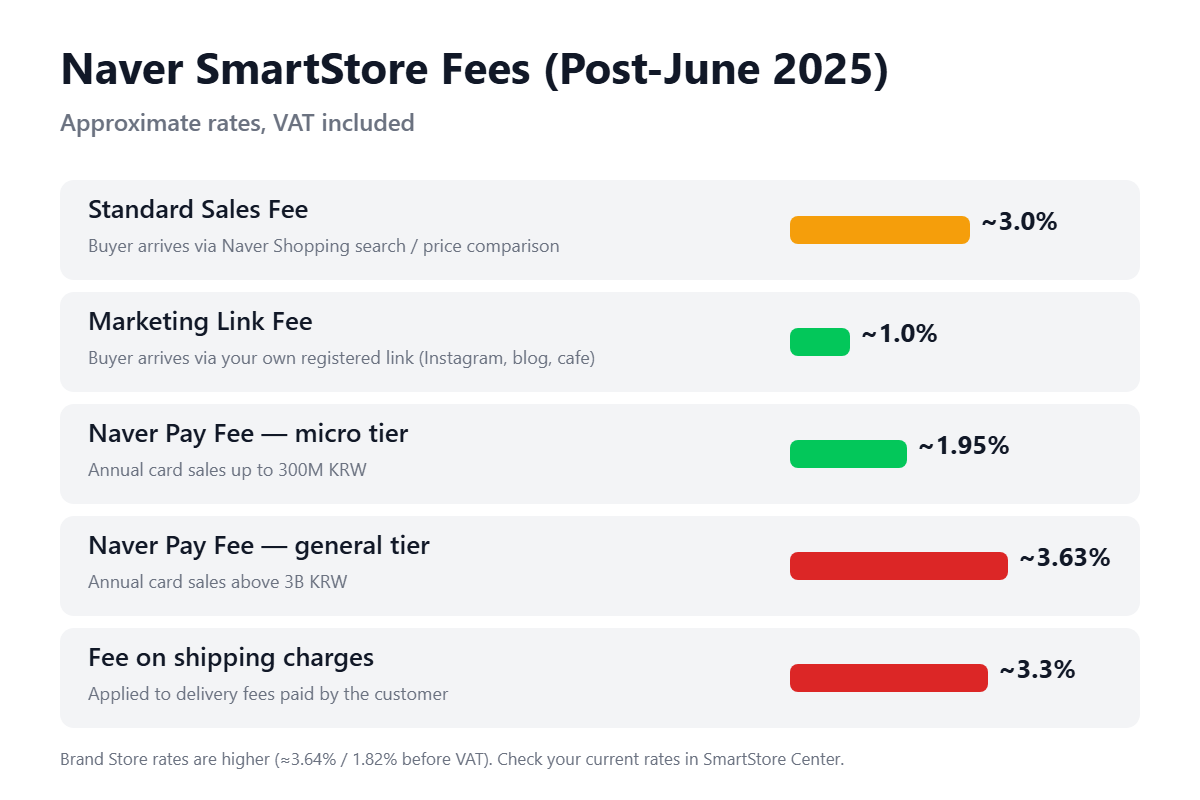
Brand Store sellers pay more: about 3.64% (standard) and 1.82% (marketing link) before VAT.
One bonus for new sellers: Naver’s Start Zero Fee (스타트제로수수료) program waives the order management fee for up to 12 months and the sales-linked fee for 6 months for eligible early-stage sellers. Check your status under Settlement Management → My Fee Info in the SmartStore Center.
Step-by-Step Profit Calculation Example (Real Numbers in KRW)
Let’s run a real example: a product sourced from Domeggook or Ownerclan and sold for 30,000 KRW with free shipping.
| Item | Amount (KRW) | Notes |
|---|---|---|
| Selling Price | 30,000 | Free shipping offered to buyer |
| Wholesale Product Cost | −18,000 | Supplier price on Domeggook/Ownerclan |
| Supplier Shipping Cost | −3,000 | Charged per order by supplier |
| Naver Sales + Payment Fees | −1,650 | ~5.5% combined (3.0% sales + ~2.5% Naver Pay) |
| Estimated VAT Reserve | −735 | 10% on value added, after input VAT credits |
| Net Profit | ≈ 6,615 | ≈ 22% net margin |
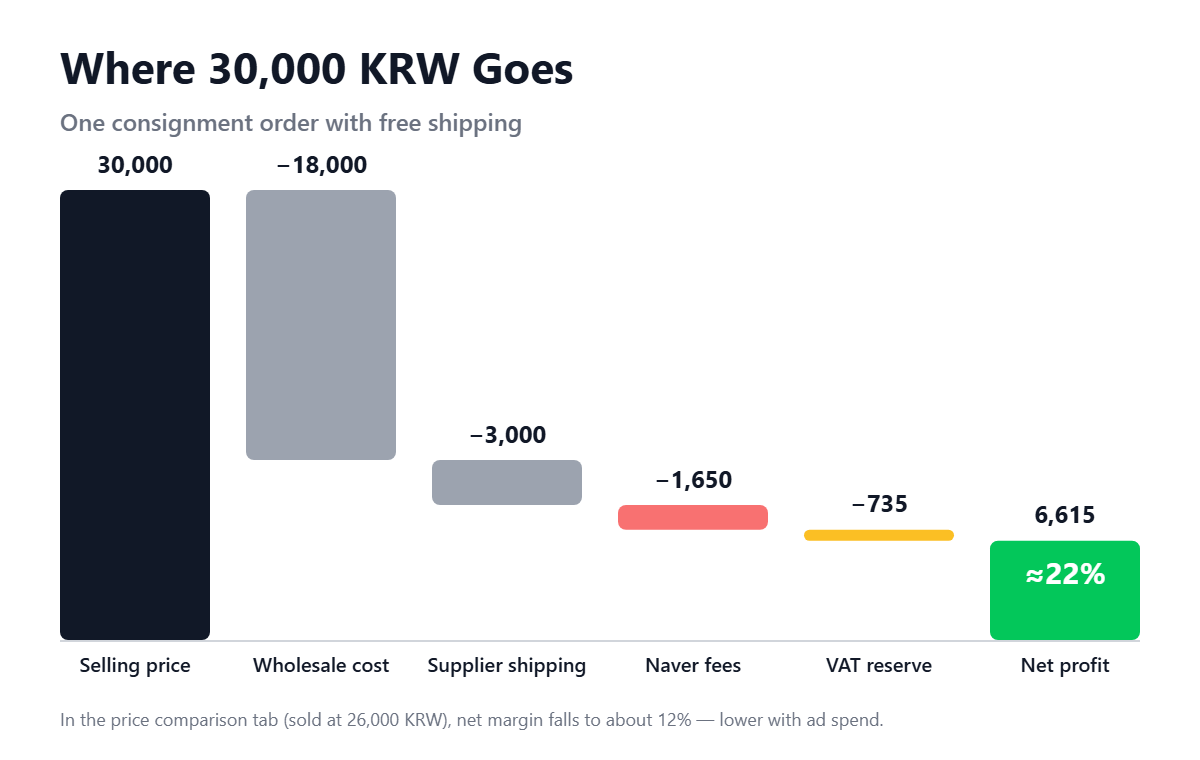
On paper, 22% looks healthy. The problem is that this assumes you can actually sell at 30,000 KRW.
What happens in the Price Comparison tab
If the same wholesale product is listed by dozens of sellers, Naver groups them under the Lowest Price Comparison (가격비교) tab. Buyers simply click the cheapest one.
Cut your price to 26,000 KRW to compete, and your net profit falls to roughly 3,100 KRW (about 12%). Add a modest Naver ad spend per sale, and you are quickly down to 8% or less. One return can wipe out the profit from five orders.
This is why consignment sellers who only compete on price rarely last more than a few months.
Hidden Costs That Eat Into Your Margins
The table above is the clean version. Real stores face extra costs that never show up in a simple margin calculation.
Return and exchange shipping
When a customer returns an item for a simple change of mind (단순변심), you often end up covering round-trip shipping, typically 6,000–7,000 KRW. On a product earning 3,000–6,000 KRW profit, a single return erases one or two sales.
Naver Search Ads (Shopping Search Ads / Power Link)
Shopping Search Ads and 파워링크 are charged per click, not per sale. If 50 clicks at 150 KRW each produce one order, that sale cost you 7,500 KRW in ads alone. Always track ad cost per order, not just clicks. Our piece on connecting campaigns to revenue explains why this matters.
Damaged or out-of-stock supplier items
You don’t control the warehouse. When a supplier runs out of stock after you’ve taken an order, you must cancel, which can hurt your seller rating and trigger Naver penalty points. Damaged goods lead to refunds you may not recover from the supplier.
4 Proven Strategies to Maximize Your Consignment Profit Margins
Improving the smartstore consignment sales profit structure is less about selling more and more about keeping more per order.
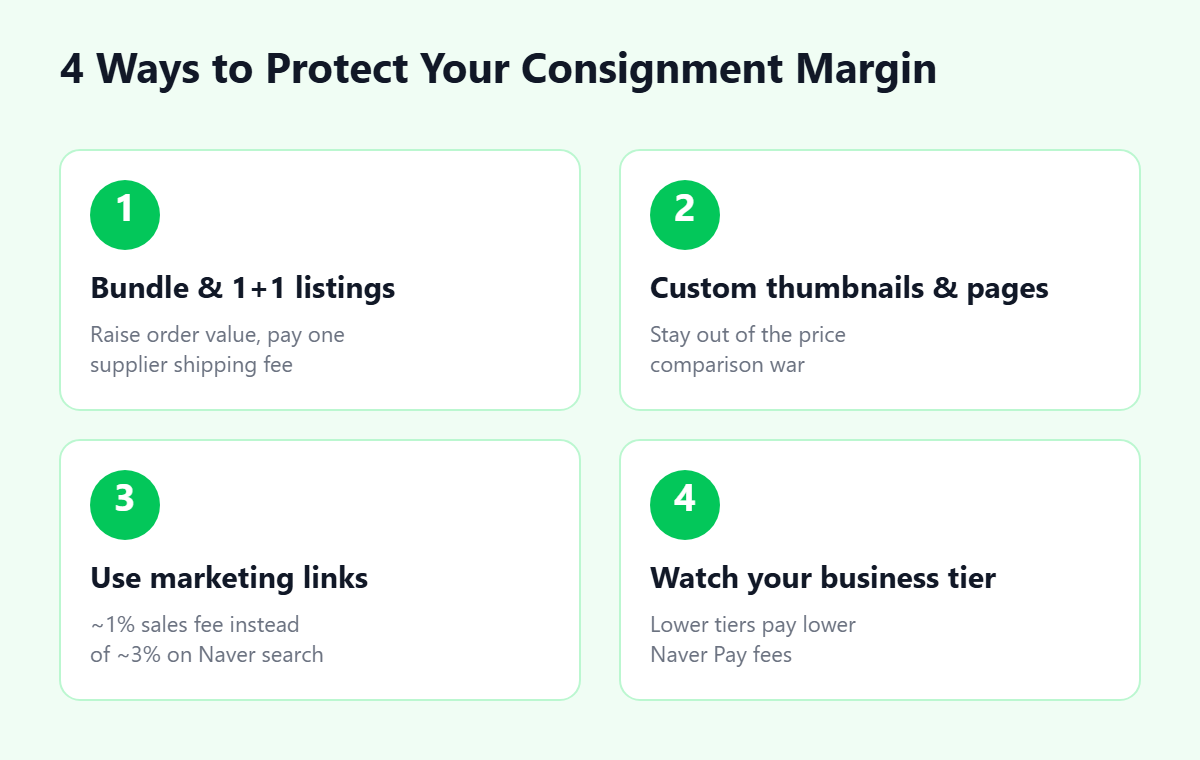
1. Bundle products or create “1+1” listings
Bundles raise your Average Order Value (AOV) while you still pay only one supplier shipping fee. Selling two units for 52,000 KRW instead of one for 30,000 KRW spreads the 3,000 KRW shipping cost across both. Bundles also create a unique listing that escapes direct price comparison.
2. Differentiate thumbnails and detail pages
If your listing uses the supplier’s stock photos and description, Naver will likely match it with every other seller. Custom thumbnails, a clearer detail page and a distinct product name help you avoid the price comparison war and sell on value rather than price.
3. Drive external traffic to unlock the 1% fee
Traffic from your own Instagram, Naver Blog or Naver Cafe posts, sent through your registered marketing link, qualifies for the ~1% sales fee instead of ~3%. On 30,000 KRW, that’s about 600 KRW saved per order. Email lists work too; start with our email marketing for beginners guide.
4. Watch your business tier for Naver Pay fees
Naver Pay processing fees depend on your registered tier (micro, small 1–3, general). Micro and small-business tiers pay noticeably lower rates than general businesses. Keep your merchant tier information up to date with the National Tax Service data, and factor in that crossing a revenue threshold (for example from 중소3 to 일반) raises your rate.
Frequently Asked Questions (FAQs)
Q1: What is the average profit margin for Naver SmartStore consignment sales?
Most consignment sellers report net margins between 10% and 25% on non-competitive products. Products that appear in the Price Comparison tab often drop to 5%–12%. Margins above 30% usually require bundling, private labeling or strong external traffic.
Q2: How much are Naver SmartStore fees in 2026?
Under the structure introduced in June 2025, a typical SmartStore order pays a ~3.0% sales fee (or ~1.0% via marketing link) plus a ~1.95%–3.63% Naver Pay order management fee. Combined, expect roughly 3%–6.6% per order. Naver revises fees periodically, so confirm the current rates in your SmartStore Center.
Q3: Do I need a Korean business license to start SmartStore consignment sales?
You can open a SmartStore as an individual seller, but to sell continuously you’ll need business registration (사업자등록) and a mail-order business report (통신판매업 신고). Most B2B wholesale platforms also require a business registration number to show wholesale prices. If you’re starting lean, our guide to starting a side business with no money covers the early steps.
Q4: How does VAT affect my consignment profit calculation?
Your selling price includes 10% VAT. As a general taxpayer, you remit the VAT on your sales minus the VAT you paid on purchases and fees (with valid tax invoices). Simplified taxpayers (간이과세자) with smaller annual sales use a lower effective rate. Always deduct a VAT reserve before calling anything “profit.”
Q5: Why is my actual payout lower than my estimated profit?
Usually because of fees applied to shipping charges, returns, discount coupons you funded, ad costs, or VAT on Naver’s fees. Settlement timing also matters: payouts arrive only after purchase confirmation. Compare your settlement statement line by line with your margin sheet.
Conclusion: Master the Numbers Before You List
The smartstore consignment sales profit structure comes down to four forces: selling price, wholesale cost plus shipping, Naver’s fees, and tax. A product that looks like a 22% winner can turn into an 8% grind the moment it lands in the price comparison tab.
The sellers who last protect margin first: they bundle, differentiate listings, drive traffic through marketing links and track every hidden cost.
Your next step: build a simple profit margin spreadsheet with columns for selling price, supplier cost, supplier shipping, Naver fees, VAT reserve, return allowance and ad cost per sale. Run every product through it before you list. If the net margin is under 15% at a realistic competitive price, skip it. For help mapping costs and goals, try our business plan template guide and browse more business tips.